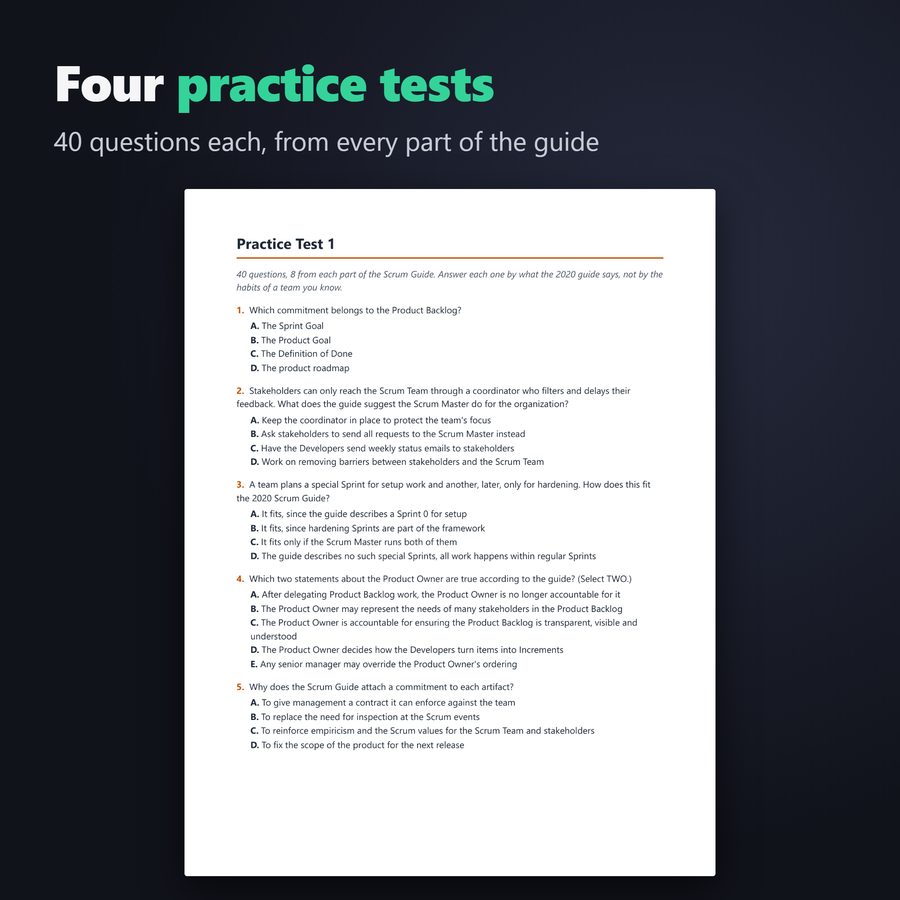
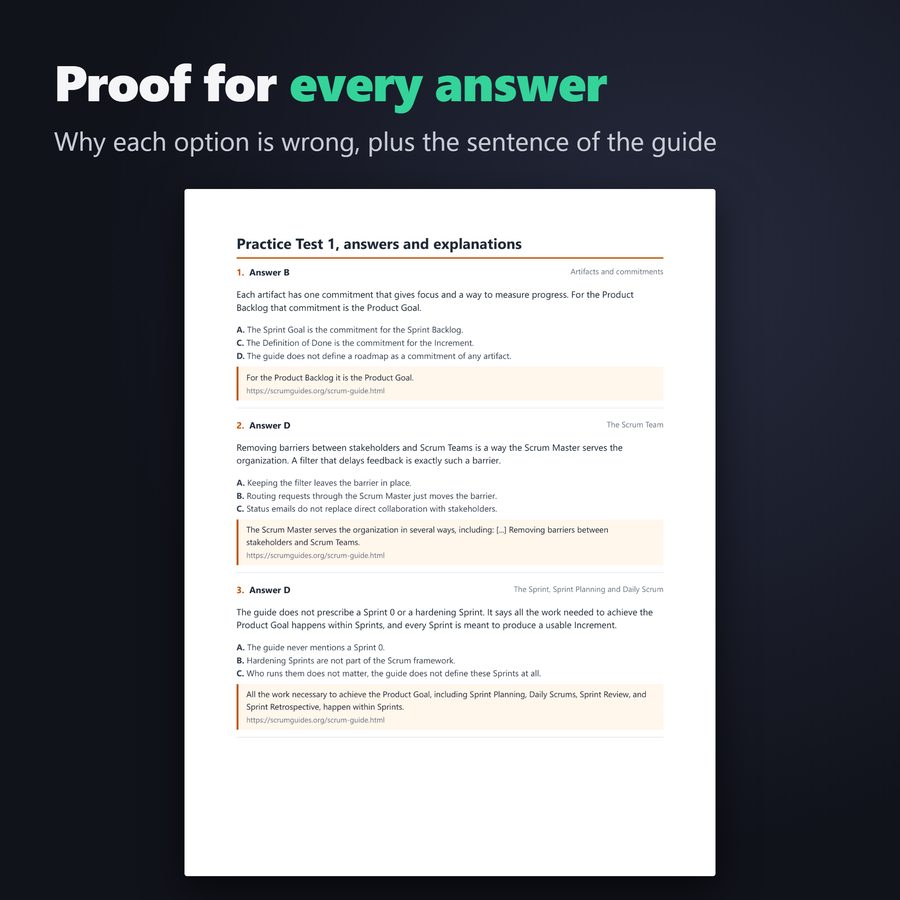
30 free Scrum Master practice questions on the 2020 Scrum Guide
Thirty questions, six from each part of the 2020 Scrum Guide, theory and values, the Scrum Team, the Sprint with Sprint Planning and Daily Scrum, Sprint Review and Retrospective, and the artifacts. Some ask for two answers.
The part that matters to me is the proof. After you check an answer, you get the sentence of the Scrum Guide that settles it. No opinions, no practices the guide does not prescribe, and if you think a question reads the guide wrongly, I would like to hear about it.
A Scrum Master asks why the Scrum Guide does not describe useful patterns and techniques that teams discover. What reason does the guide give?
Answer D. The guide limits itself to the definition of Scrum. Tactics depend on context, so they are left out and described elsewhere.
- A. The guide says such patterns may be found, applied and devised within Scrum.
- B. The guide gives no reason based on the age of a technique.
- C. The guide mentions no such handbook. It says they are described elsewhere.
“Their description is beyond the purpose of the Scrum Guide because they are context sensitive and differ widely between Scrum uses.”
scrumguides.org/scrum-guide.html
Instead of giving people detailed instructions, what does the Scrum Guide say the rules of Scrum do?
Answer C. Scrum avoids step-by-step instructions. Its rules shape how people work together, which leaves room for their own methods.
- A. The guide says it does not give detailed instructions.
- B. The guide does not describe job titles or reporting lines.
- D. The guide does not name any tools.
“Rather than provide people with detailed instructions, the rules of Scrum guide their relationships and interactions.”
scrumguides.org/scrum-guide.html
A Scrum Team stops producing a weekly status report that nobody reads. Which part of Scrum theory supports this choice?
Answer D. An unread report is waste. Lean thinking asks the team to drop it and focus on what matters.
- A. Transparency is about making work visible, not keeping unread reports.
- B. The value of commitment is about goals and mutual support, not documents.
- C. Inspection depends on transparent artifacts, not on the number of reports.
“Lean thinking reduces waste and focuses on the essentials.”
scrumguides.org/scrum-guide.html
With Scrum, important decisions are based on the perceived state of what?
Answer A. The Product Backlog, Sprint Backlog and Increment are the basis for decisions. That is why they must be transparent.
- B. The guide bases decisions on the artifacts, not on seniority.
- C. Performance reviews are not part of Scrum.
- D. Velocity charts are not part of the 2020 Scrum Guide.
“With Scrum, important decisions are based on the perceived state of its three formal artifacts.”
scrumguides.org/scrum-guide.html
In a company, Developers need a manager's approval for any change to how they work. What does the Scrum Guide say about this?
Answer B. Teams that must ask permission adapt slowly. The guide links quick adaptation to empowered, self-managing people.
- A. The guide says a lack of empowerment makes adaptation harder.
- C. The guide expects self-managing teams to adapt.
- D. The guide gives the Product Owner no such role.
“Adaptation becomes more difficult when the people involved are not empowered or self-managing.”
scrumguides.org/scrum-guide.html
A manager trusts the Developers to decide how to build a feature, treating them as capable and independent. Which value does this reflect?
Answer C. Respect in Scrum means seeing each other as capable, independent people. It also covers how others treat the team.
- A. Courage is about doing the right thing, not how people regard each other.
- B. Openness is about being open about the work and challenges.
- D. Focus is about attention on the work of the Sprint.
“Scrum Team members respect each other to be capable, independent people, and are respected as such by the people with whom they work.”
scrumguides.org/scrum-guide.html
A Scrum Team has grown to 16 people and decides to split into two Scrum Teams working on the same product. What should the two teams share?
Answer C. When a Scrum Team becomes too large, the guide suggests reorganizing into several cohesive Scrum Teams focused on the same product. Because they serve one product, they share one Product Goal, one Product Backlog and one Product Owner.
- A. The guide says teams on the same product share the same Product Owner.
- B. Teams on the same product share one Product Goal.
- D. Each Scrum Team has its own Sprint Backlog and its own Daily Scrum for its Developers.
“If Scrum Teams become too large, they should consider reorganizing into multiple cohesive Scrum Teams, each focused on the same product. Therefore, they should share the same Product Goal, Product Backlog, and Product Owner.”
scrumguides.org/scrum-guide.html
In one company, a separate operations group runs and maintains everything the Scrum Team builds. According to the guide, who is responsible for product-related activities such as verification, maintenance and operation?
Answer C. The guide makes the Scrum Team responsible for all product-related activities, from stakeholder collaboration to maintenance, operation and research. Handing these to another group splits work the guide keeps inside the team.
- A. The guide places these activities with the Scrum Team, not an outside group.
- B. The responsibility belongs to the whole Scrum Team, not one accountability.
- D. The Scrum Guide does not describe a project management office.
“The Scrum Team is responsible for all product-related activities from stakeholder collaboration, verification, maintenance, operation, experimentation, research and development, and anything else that might be required.”
scrumguides.org/scrum-guide.html
An organization wants every Developer to hold one of a fixed list of job titles, such as tester or analyst. What does the Scrum Guide say about the skills Developers need?
Answer A. The guide says the specific skills Developers need are often broad and vary with the domain of work. It defines no job titles or specialties within the Developers.
- B. Developers are not limited to software skills, the work varies by domain.
- C. The Scrum Master does not set the team's skills.
- D. The guide defines no specialties among the Developers.
“The specific skills needed by the Developers are often broad and will vary with the domain of work.”
scrumguides.org/scrum-guide.html
A sales director wants a feature moved to the top of the Product Backlog. How does the guide say this should happen?
Answer D. Anyone who wants to change the Product Backlog does it by trying to convince the Product Owner. The Product Owner orders the items and the organization respects those decisions.
- A. Ordering the Product Backlog belongs to the Product Owner.
- B. The Scrum Master does not order the Product Backlog.
- C. Going around the Product Owner to the Developers bypasses the person who orders the work.
“Those wanting to change the Product Backlog can do so by trying to convince the Product Owner.”
scrumguides.org/scrum-guide.html
Which statement matches what the 2020 Scrum Guide says about the Scrum Team's effectiveness?
Answer A. The guide makes the Scrum Master accountable for the Scrum Team's effectiveness. The Scrum Master does this by enabling the team to improve its practices within Scrum. Velocity is not part of the guide.
- B. The guide gives this accountability to the Scrum Master, not to functional managers.
- C. The guide names the Scrum Master as accountable.
- D. The guide does not prescribe velocity or any such measure.
“The Scrum Master is accountable for the Scrum Team’s effectiveness. They do this by enabling the Scrum Team to improve its practices, within the Scrum framework.”
scrumguides.org/scrum-guide.html
Which two statements about the Product Owner are true according to the guide? (Select TWO.)
Answer B, C. One Product Owner can represent many stakeholders in the Product Backlog. Making sure the Product Backlog is transparent, visible and understood is part of their Product Backlog management.
- A. The Product Owner remains accountable after delegating.
- D. How work is turned into Increments is at the sole discretion of the Developers.
- E. The entire organization must respect the Product Owner's decisions.
“The Product Owner may represent the needs of many stakeholders in the Product Backlog. [...] Ensuring that the Product Backlog is transparent, visible and understood.”
scrumguides.org/scrum-guide.html
A department head wants to add three weekly coordination meetings for a Scrum Team. What does the guide say the Scrum events are meant to do in this respect?
Answer D. The guide says the events create regularity and reduce the need for meetings that Scrum does not define. Adding many extra meetings suggests the events are not doing their job.
- A. The guide aims to minimize extra meetings, not to pile events on top of them.
- B. The Product Owner is not given the role of choosing which meetings to replace.
- C. The events keep their prescribed cadence whatever other meetings exist.
“Events are used in Scrum to create regularity and to minimize the need for meetings not defined in Scrum.”
scrumguides.org/scrum-guide.html
A sponsor asks how Scrum makes delivery more predictable. Which answer reflects the Scrum Guide?
Answer C. The guide links predictability to the Sprint. Each Sprint ensures progress toward the Product Goal is inspected and adapted at least every calendar month.
- A. Fixing all scope upfront is not how the guide describes predictability.
- B. The guide caps Sprints at one month and does not require two weeks.
- D. Weekly reports by the Scrum Master are not part of the guide.
“Sprints enable predictability by ensuring inspection and adaptation of progress toward a Product Goal at least every calendar month.”
scrumguides.org/scrum-guide.html
At the start of Sprint Planning, which part of the first topic is the Product Owner's to propose?
Answer A. For the first topic, the guide has the Product Owner propose how the product could increase its value and utility in the Sprint. The whole Scrum Team then shapes the Sprint Goal from there.
- B. Developers are self-managing and decide who does what.
- C. Planning the work is for the Developers, and the guide does not require hour estimates.
- D. The Definition of Done is not set by the Product Owner during the first topic.
“The Product Owner proposes how the product could increase its value and utility in the current Sprint.”
scrumguides.org/scrum-guide.html
A team using one-month Sprints asks for the Sprint Planning timebox. What is it?
Answer D. Sprint Planning is timeboxed to a maximum of eight hours for a one-month Sprint. Four hours is the Sprint Review timebox for the same Sprint length.
- A. Two hours is not a timebox the guide gives for Sprint Planning.
- B. Four hours is the maximum for the Sprint Review of a one-month Sprint.
- C. Twelve hours exceeds the maximum the guide sets.
“Sprint Planning is timeboxed to a maximum of eight hours for a one-month Sprint.”
scrumguides.org/scrum-guide.html
A Developer says changes to the plan may only be made during the Daily Scrum. What does the guide say?
Answer B. The guide says the Daily Scrum is not the only time Developers may adjust their plan. They often meet during the day to discuss adapting or re-planning the rest of the Sprint's work.
- A. The guide explicitly says the Daily Scrum is not the only moment.
- C. The Sprint Backlog keeps changing after Sprint Planning as more is learned.
- D. The Developers own their plan and need no approval to change it.
“The Daily Scrum is not the only time Developers are allowed to adjust their plan.”
scrumguides.org/scrum-guide.html
A team wants to drop the classic three questions at the Daily Scrum. Which two conditions does the guide set for whatever format they choose? (Select TWO.)
Answer A, D. The guide lets Developers use any structure and techniques. The only conditions are that the Daily Scrum focuses on progress toward the Sprint Goal and produces an actionable plan for the next day.
- B. The guide does not prescribe three questions.
- C. Recording answers is not required by the guide.
- E. The Developers choose the format without needing approval.
“The Developers can select whatever structure and techniques they want, as long as their Daily Scrum focuses on progress toward the Sprint Goal and produces an actionable plan for the next day of work.”
scrumguides.org/scrum-guide.html
A team works in two-week Sprints. How does the Scrum Guide describe the length of its Sprint Review compared with a one-month Sprint?
Answer A. The guide gives the maximum for a one-month Sprint and says that for shorter Sprints the event is usually shorter. It does not give an exact formula.
- B. The guide does not prescribe a proportional calculation.
- C. Four hours is a maximum for one-month Sprints, not a fixed length for all Sprints.
- D. Stakeholders do not set the timebox of Scrum events.
“For shorter Sprints, the event is usually shorter.”
scrumguides.org/scrum-guide.html
A Scrum Master notices that Sprint Reviews have become one-way slide shows with no questions. What does the Scrum Guide say about this?
Answer D. The guide calls the Sprint Review a working session. A one-way presentation misses the collaboration the event is meant to produce.
- A. The guide warns against limiting the event to a presentation.
- B. The guide does not describe the Sprint Review as an acceptance meeting.
- C. Collaboration happens during the event, not only afterwards.
“The Sprint Review is a working session and the Scrum Team should avoid limiting it to a presentation.”
scrumguides.org/scrum-guide.html
During a Sprint Retrospective, the team looks at its tools, its processes and how its members interact. Which other item does the Scrum Guide explicitly list for inspection in this event?
Answer C. The guide lists individuals, interactions, processes, tools and the Definition of Done. The Retrospective is therefore a natural place to strengthen the Definition of Done.
- A. Progress toward the Product Goal is discussed at the Sprint Review. It is not listed for the Retrospective.
- B. Pay is not a Scrum topic at all.
- D. The guide does not mention satisfaction scores.
“The Scrum Team inspects how the last Sprint went with regards to individuals, interactions, processes, tools, and their Definition of Done.”
scrumguides.org/scrum-guide.html
A manager describes Sprints as arbitrary two-week slices of one long project, with no goal of their own. How does the Scrum Guide describe each Sprint?
Answer C. The guide says each Sprint may be considered a short project. It has its own Sprint Goal and produces value, rather than being a slice of someone else's plan.
- A. The guide does not define the Sprint as a reporting period.
- B. The guide describes no sequential phases.
- D. The Developers plan their own work, nobody assigns a batch of tasks.
“Each Sprint may be considered a short project.”
scrumguides.org/scrum-guide.html
During refinement, a Product Owner thinks the Developers' size for an item is too large. What role does the Scrum Guide give the Product Owner here?
Answer B. Developers own the sizing. The Product Owner can still help them understand and choose trade-offs, which may lead them to a different size.
- A. Sizing is the responsibility of the Developers.
- C. The guide sets no escalation path for sizing.
- D. The Product Owner takes part and may influence the Developers.
“The Product Owner may influence the Developers by helping them understand and select trade-offs.”
scrumguides.org/scrum-guide.html
Which statements about Product Backlog refinement match the Scrum Guide? (Select TWO.)
Answer A, C. Refinement is ongoing and adds details such as description, order and size. The Developers who will do the work size the items.
- B. Refinement is not a Scrum event and has no timebox.
- D. Sizing belongs to the Developers who will do the work.
- E. The Product Backlog is refined as needed throughout the Sprint.
“This is an ongoing activity to add details, such as a description, order, and size.”
scrumguides.org/scrum-guide.html
Why does the Scrum Guide attach a commitment to each artifact?
Answer C. The guide says the commitments reinforce empiricism and the Scrum values. They give a clear target against which progress can be measured and adapted.
- A. Commitments are not contracts. They exist to support empiricism and the values.
- B. Commitments support inspection, they do not replace it.
- D. The Product Backlog is emergent, so commitments do not freeze scope.
“These commitments exist to reinforce empiricism and the Scrum values for the Scrum Team and their stakeholders.”
scrumguides.org/scrum-guide.html
A company wants every Product Backlog item, in every team, to carry the same fixed set of fields, story points included. What does the Scrum Guide say about the attributes of Product Backlog items?
Answer A. Refinement adds details such as a description, order and size, but the guide says attributes often vary with the domain of work. It does not prescribe a fixed template, and it never mentions story points.
- B. The guide does not prescribe story points or a fixed set of fields.
- C. The Scrum Master is not given authority over item attributes.
- D. Refinement adds details such as a description, order and size.
“Attributes often vary with the domain of work.”
scrumguides.org/scrum-guide.html
A department manager adds tasks directly to the team's Sprint Backlog without talking to anyone. Whose plan is the Sprint Backlog according to the Scrum Guide?
Answer A. The Developers create and own the Sprint Backlog. A manager adding tasks bypasses the people who own the plan and weakens self-management.
- B. The Product Owner is accountable for the Product Backlog, not the Sprint Backlog plan.
- C. Stakeholders do not edit the Developers' plan.
- D. The Scrum Master does not own the Sprint Backlog.
“The Sprint Backlog is a plan by and for the Developers.”
scrumguides.org/scrum-guide.html
Midway through a Sprint, the Developers learn that the selected work is larger than expected. What should they do?
Answer C. Scope in the Sprint Backlog can flex, the Sprint Goal does not. The Developers work it out with the Product Owner.
- A. The guide says scope is negotiated without affecting the Sprint Goal.
- B. Sprints have a fixed length and are not extended.
- D. Quality does not decrease, and the Definition of Done stays in force.
“If the work turns out to be different than they expected, they collaborate with the Product Owner to negotiate the scope of the Sprint Backlog within the Sprint without affecting the Sprint Goal.”
scrumguides.org/scrum-guide.html
At what moment does the Scrum Guide say an Increment is born?
Answer A. An Increment exists as soon as an item meets the Definition of Done. Timing within the Sprint does not matter.
- B. The Sprint Review presents Increments that already exist.
- C. Release comes after an Increment exists, not before.
- D. Increments can be born at any point in the Sprint.
“The moment a Product Backlog item meets the Definition of Done, an Increment is born.”
scrumguides.org/scrum-guide.html
Under deadline pressure, a Developer suggests skipping a review step that the Definition of Done requires, just for this Sprint. What does the Scrum Guide say?
Answer B. Conforming to the Definition of Done is not optional. Skipping a step means the work is not Done and cannot be part of an Increment.
- A. The guide makes no exception for Product Owner agreement.
- C. The Scrum Master has no power to waive the Definition of Done.
- D. The guide does not describe hardening Sprints.
“The Developers are required to conform to the Definition of Done.”
scrumguides.org/scrum-guide.html
These 30 come from a set of 200, four tests of 40 plus a 40 question drill, in one PDF with the same answer key. It is 9 euros on Ko-fi, no account needed to buy.
If you would rather sit them timed in the browser with a score by domain at the end, the same 200 questions are also a Udemy practice test course, 12.99 dollars with that link until November 4.